
Asha Trust - Manigal Kottur
Asha Trust - Manigal Kottur

Project Brief: To promote education as a tool to change the marginal status of the gypsies. To use schooling as a tool to keep children in a safe environment and away from work
Project Type: Other (description)
Primary Focus: to go to formal school (description)
Supporting Chapter Contact:
Chennai
Project Type: Other (description)
Primary Focus: to go to formal school (description)
Secondary Focus: remedial education
Area: TribalSupporting Chapter Contact:
Chennai
Status: CURRENT
Project Steward: Usha bhaskar
Project Partner(s): Rajaraman Krishnan
Project Address: Asha Trust - Manigal Kottur
First Floor, 85/2, Luz Avenue, Mylapore, Chennai 600004
Near Nageswara rao park
Chennai, Tamil Nadu 600004
Tel:
Stewarding Chapter: Chennai
Project Steward: Usha bhaskar
Project Partner(s): Rajaraman Krishnan
Project Address: Asha Trust - Manigal Kottur
First Floor, 85/2, Luz Avenue, Mylapore, Chennai 600004
Near Nageswara rao park
Chennai, Tamil Nadu 600004
Tel:
Stewarding Chapter: Chennai
From 2022, the updaes will be given in Manigal page (https://ashanet.org/project/?pid=1160)
<span><b><i>The gypsy children get sucked into the rag picking profession at an early stage. In this context schooling becomes an important tool to change their marginalized status.</i></b></span>
The gypsy community is one of the most marginalized communities, socially, economically and educationally. Though a settled community now, they continue their nomadic style and travel often. Their children are often left out of the fruits of educational benefits.
The process of starting a new project, Manigal - Kottur was initiated in 2015, after a decade long experience in working with gypsy children in a colony in South Chennai, where the intervention has resulted in
<ul>
<li>improved school enrolment and retention of gypsy children.</li><li>children continuing their education beyond primary education into higher education.</li><li>weaning children away from joining the profession of garbage clearing at an early age.</li></ul>
The understanding gained over the years about the issues confronting gypsy education gave the confidence to extend the project to a new gypsy colony where the drop out rate of gypsy children was very high. Manigal - Kotturreaches out to gypsy children in a colony in Central Chennai which has over 150 gypsy families. Originally a completely gypsy inhabited colony, over a period of time, the houses seemed to have changed hands. So the colony has a mixed population of gypsies and Tamil families.
Many gypsy children from the colony do get enrolled in schools initially. But due to social, cultural and language differences their adjustment in school is not smooth. The corporation school and another aided school are at a 5 min walking distance from the colony. Inside school gypsy children often want to remain together in their own groups, talk in their own language and remain indifferent to the teaching process. Used to a freer, independent and interesting life style they find it difficult to confine to classroom norms, routines and procedures. Some make an early exit while others absent themselves frequently. With poor learning levels, they soon lose confidence and become drop outs. Out of school, they join their parents in the profession of rag picking and the vicious cycle continues.
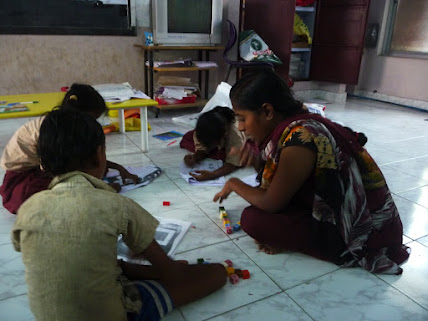
The project posts additional teachers in the local school where majority of the gypsy children study. Working with gypsy children in small sub groups, it provides an opportunity to gypsy children to interact in their own language and stay with their peers till they settle down in school. It uses creative learning methods to generate interest in the learning process and sustain them in school. Over a period of time, the project proposes to narrow the learning gap between gypsy children and others.
Changing the educational statues of one generation of gypsies is essential to change their marginalized status
<span><b><i>The gypsy children get sucked into the rag picking profession at an early stage. In this context schooling becomes an important tool to change their marginalized status.</i></b></span>
The gypsy community is one of the most marginalized communities, socially, economically and educationally. Though a settled community now, they continue their nomadic style and travel often. Their children are often left out of the fruits of educational benefits.
The process of starting a new project, Manigal - Kottur was initiated in 2015, after a decade long experience in working with gypsy children in a colony in South Chennai, where the intervention has resulted in
<ul>
<li>improved school enrolment and retention of gypsy children.</li><li>children continuing their education beyond primary education into higher education.</li><li>weaning children away from joining the profession of garbage clearing at an early age.</li></ul>
The understanding gained over the years about the issues confronting gypsy education gave the confidence to extend the project to a new gypsy colony where the drop out rate of gypsy children was very high. Manigal - Kotturreaches out to gypsy children in a colony in Central Chennai which has over 150 gypsy families. Originally a completely gypsy inhabited colony, over a period of time, the houses seemed to have changed hands. So the colony has a mixed population of gypsies and Tamil families.
Many gypsy children from the colony do get enrolled in schools initially. But due to social, cultural and language differences their adjustment in school is not smooth. The corporation school and another aided school are at a 5 min walking distance from the colony. Inside school gypsy children often want to remain together in their own groups, talk in their own language and remain indifferent to the teaching process. Used to a freer, independent and interesting life style they find it difficult to confine to classroom norms, routines and procedures. Some make an early exit while others absent themselves frequently. With poor learning levels, they soon lose confidence and become drop outs. Out of school, they join their parents in the profession of rag picking and the vicious cycle continues.
The project posts additional teachers in the local school where majority of the gypsy children study. Working with gypsy children in small sub groups, it provides an opportunity to gypsy children to interact in their own language and stay with their peers till they settle down in school. It uses creative learning methods to generate interest in the learning process and sustain them in school. Over a period of time, the project proposes to narrow the learning gap between gypsy children and others.
Changing the educational statues of one generation of gypsies is essential to change their marginalized status
Feb 2026 RightStart 2026
Dec 2025 Asha Chennai Assessment Analysis
Jun 2024 Report on RightStart 2024
Jan 2024 Site visit report manigal kottur
Nov 2023 Oral Assessment Report - Nov 2023
Mar 2022 Site Visit Report
May 2021 Report of manigal Kottur 2020-2021
Jan 2021 Site visit report manigal Kottur
Aug 2020 Report of online classes
May 2020 Report of manigal Kottur 2019-2020
May 2019 Report of manigal Kottur 2018-2019
Jan 2019 dummy-link
Oct 2018 Site visit report - Oct 2018
Apr 2018 Manigal - Kottur report for 2017-18
Oct 2017 Site visit report - Oct 2017
May 2017 Photos of children in kottur school
May 2017 Report for year 2016-17
Nov 2016 Site visit report from Usha Bhaskar
May 2016 Manigal -Kottur Asha Report 2016
Aug 2015 Photos from site visit
Apr 2015 Site visit report